

Home Healthcare Agencies
Home / Who We Serve / Home Healthcare
The Care Happens Fast. Don't Let The Denials Catch Up To You.
Full revenue cycle, staffing, and operations support built for how home health actually works.
Home health is competitive and unforgiving. Care runs continuously across an episode, so a skipped eligibility check or missed authorization can turn into denials across many visits, not one. By the time a denial arrives, the cost is already spent. MediCommerce provides Core Billing, Staffing Solutions, and Health Care Operations built around that reality.
What We Do For You
Before The Service
Every episode starts with eligibility verification. We confirm the patient's policy is active. We confirm your agency is in network for that specific plan. Skipping this step is one of the fastest ways to end up with a denial that was fully preventable. From there we validate benefits by visit type. A plan covering skilled nursing does not automatically cover therapy or home health aide visits. Assuming otherwise creates avoidable denials.
We also work closely with your practice owner or operations manager on financial clearance. We do not collect payment information from patients directly. Instead, we walk your team through the deductible, cost share, and out of pocket costs so they know exactly what a patient owes. We educate your team on the denial trends we are seeing, so your practice can build its own process for collecting copays and deductibles from patients directly.
Prior authorization is where the line is firmest. If authorization is not obtained, the claim will be denied. There is no exception. This is not a risk to manage after the fact, it is a rule to follow before the visit happens. If authorization is not in place, if the patient is not eligible, or if the plan is out of network, the service should not be provided. We build this understanding into your team’s process, not just our own, so the decision gets made correctly before care ever starts. Once authorization is confirmed, we track unit utilization for the full episode, since most members are limited to around 60 authorized units per year.
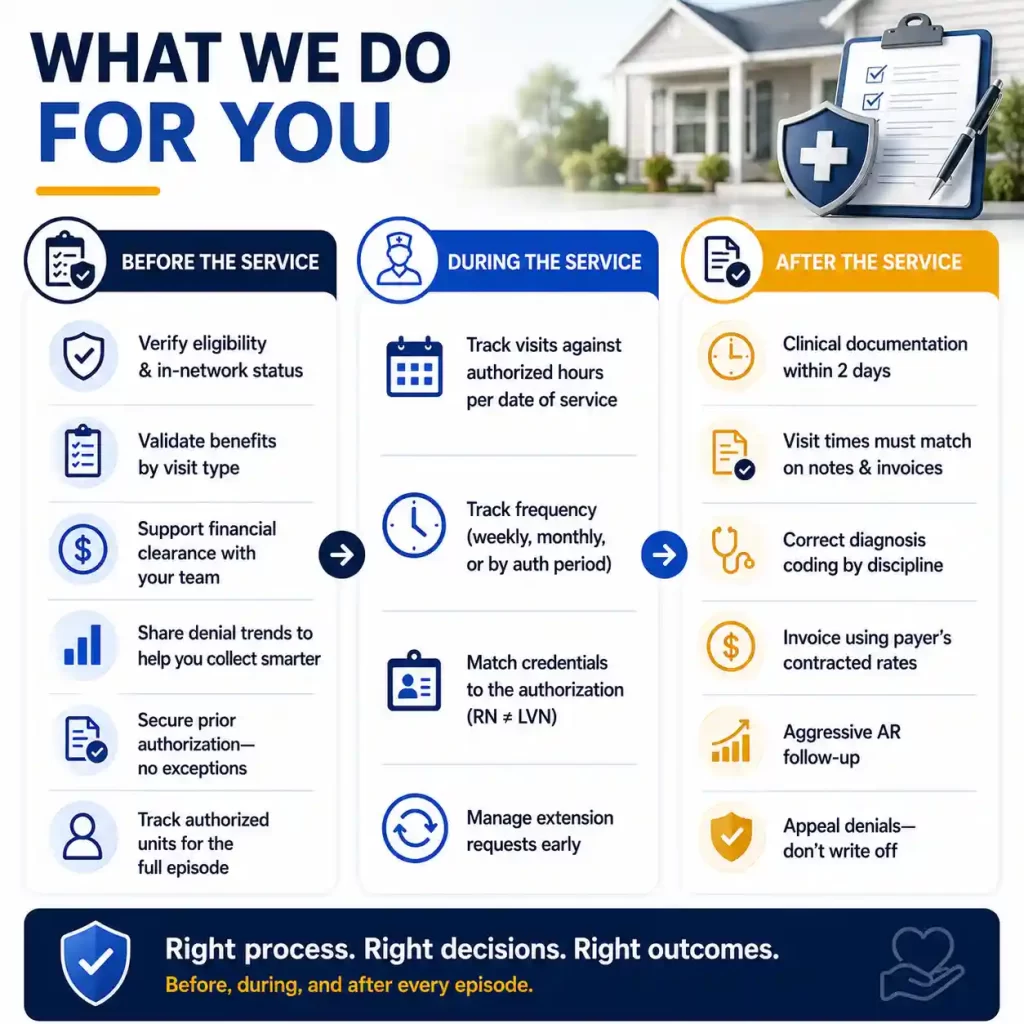
During The Service
Care has to stay inside what was actually authorized. We track visits against the approved hours per date of service. We track visits against the approved frequency for the week, month, or authorization period. We also track the credential the authorization was written for. An authorization approved for an RN is not fulfilled by an LVN. When an episode is approaching the edge of its authorized units or its authorization period, we manage the extension request early, not after care has already lapsed.
After The Service
Clinical documentation is expected within two days of each visit. Visit start and end times must match exactly between the clinical note and the invoice. Mismatches are a leading trigger for payer audits and clawbacks. Diagnosis coding is applied correctly by discipline, since using the same code across skilled nursing and therapy visits is a common and avoidable denial trigger. Every invoice is built from the payer's contracted fee schedule for that specific plan.
Accounts receivable follow up runs on an aggressive cadence. In home health, aging AR is not just slow revenue, it is revenue tied to care that has already been delivered and already cost your agency money. When a denial does occur, our default posture is to appeal rather than write off, since a large share of appealed authorization denials succeed when pursued.
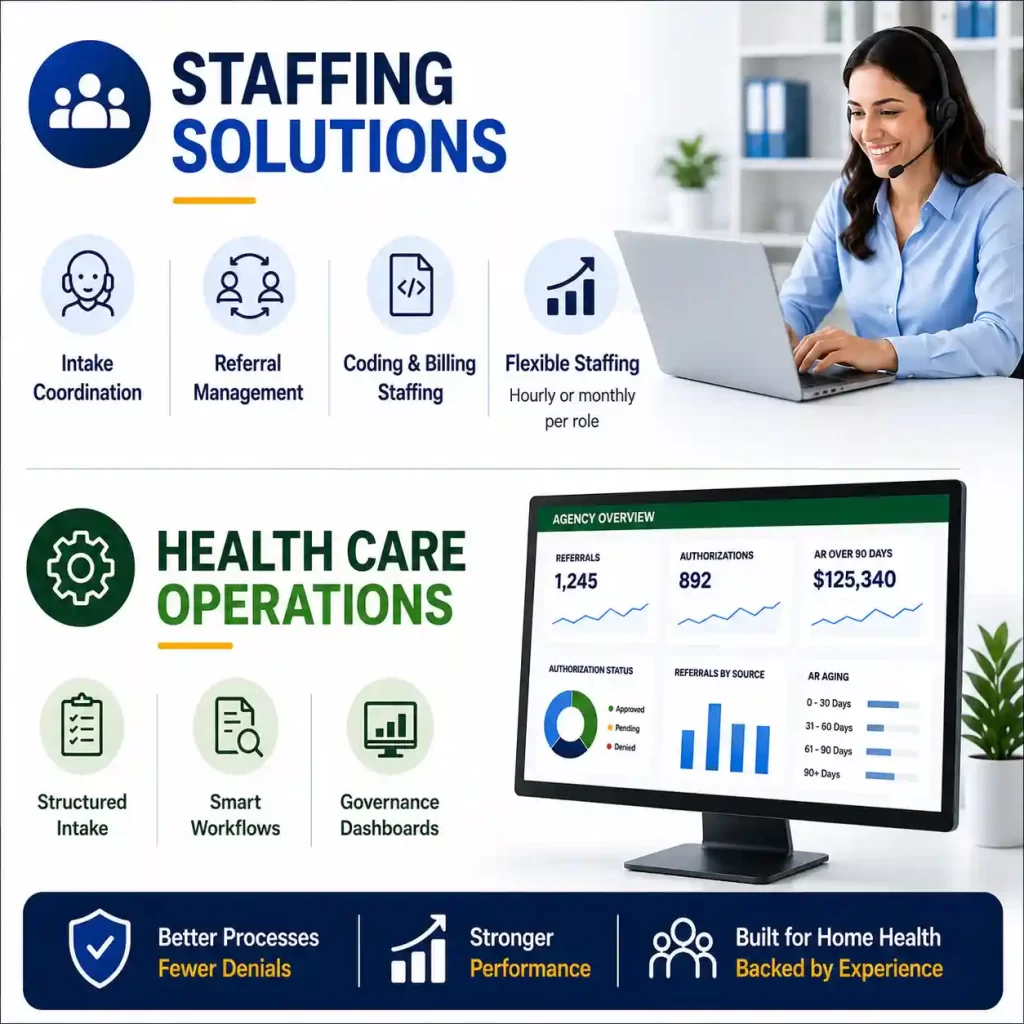
Staffing Solutions
Home health agencies often need help beyond billing alone. That might mean intake coordination, referral management, or additional coding and billing staff during periods of growth or turnover. MediCommerce can place staff into any of these roles individually, billed hourly or as a fixed monthly cost per role, so you can scale support up or down as referral volume shifts.
Health Care Operations
We help structure the referral intake process so plan type, network status, and authorization requirements are confirmed before a referral is even accepted. We build the documentation matching and reauthorization tracking workflows that catch problems before they become denials. We also provide governance dashboards that give you visibility into referral volume, authorization status, and AR performance across your agency.
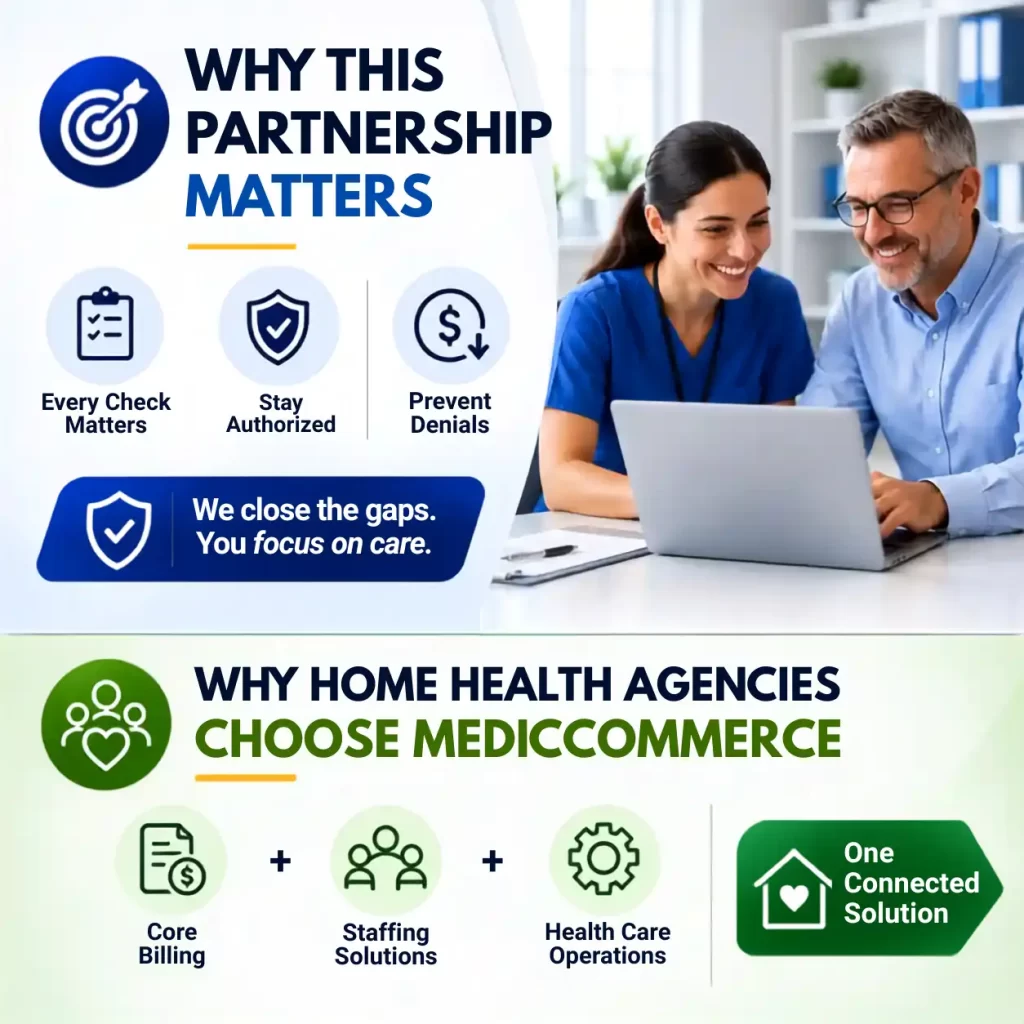
Why This Partnership Matters
In a market as competitive as home health, referral sources send patients to agencies they trust to be financially stable and operationally reliable. Every eligibility check that gets skipped costs you. Every authorization that lapses unnoticed costs you. Every denial that surfaces weeks after care was delivered costs you twice, once in lost revenue and once in the time it takes to chase it. MediCommerce is built to close that gap before it opens, so your agency can compete on the quality of care it delivers, not on how well it survives its own revenue cycle.
Why Home Health Agencies Choose MediCommerce
Most home health agencies end up stitching together a billing vendor, a staffing agency, and internal operations oversight separately. That approach leaves gaps at exactly the points where authorization issues and denials tend to slip through. MediCommerce provides Core Billing, Staffing Solutions, and Health Care Operations as one connected service. Authorization tracking, staffing coverage, and workflow oversight are never working from different information at different times.
FAQ
Do you work with Medicare home health claims, or only Commercial and Medicaid?
Our home health experience is concentrated in Commercial and State Medicaid claims, which make up the majority of most agencies’ payer mix.
Do you collect copays and deductibles directly from patients?
No. We work with your practice owner or operations manager instead. We walk them through the deductible and cost share details for each patient. We document the details as notes in the EHR, and we share the denial trends we are seeing across your claims.
What happens if a service is provided without an approved authorization?
It will be denied. There is no exception to this. If authorization is not in place, if the patient is not eligible, or if the plan is out of network, our guidance is that the service should not be provided. We treat this as a rule to follow before the visit, not a risk to manage after the claim is filed.
How do you prevent unit exhaustion before it happens?
We track each patient’s authorized unit count against units actually delivered while billing to insurance. Your team is alerted before a patient runs out of authorized visits, rather than finding out after a claim is denied.
Why does clinical documentation need to be completed within two days of the date of service?
Billing depends on documentation being accurate and current. The longer a note sits unfinished, the more likely details get missed or misremembered, and the further behind your claims fall. A two day turnaround keeps documentation close enough to the visit to stay accurate, and keeps your billing cycle moving instead of stacking up delays.
Why does interoperability between the director of nursing, home health aide coordinator, clinical staff, director of operations, billing, and front end staff matter so much?
Every one of these roles touches a piece of the same episode of care. If the director of nursing does not know about an authorization limit, or billing does not know a visit schedule changed, small gaps open up between departments. Those gaps are exactly where denials come from. When these roles stay connected and share information consistently, the whole revenue cycle moves as one process instead of several disconnected ones, and that is what keeps an agency’s financial health at the standard it needs to be.
Can you help with staffing shortages in addition to billing?
Yes. Staffing Solutions can place intake coordinators, referral staff, or billing and coding support into your agency on an hourly or fixed monthly basis, depending on what you need.