

What Is Revenue Cycle Management? A Physician's Guide to the RCM Process in 2026
Home / Case studies / What Is Revenue Cycle Management? A Physician’s Guide to the RCM Process in 2026
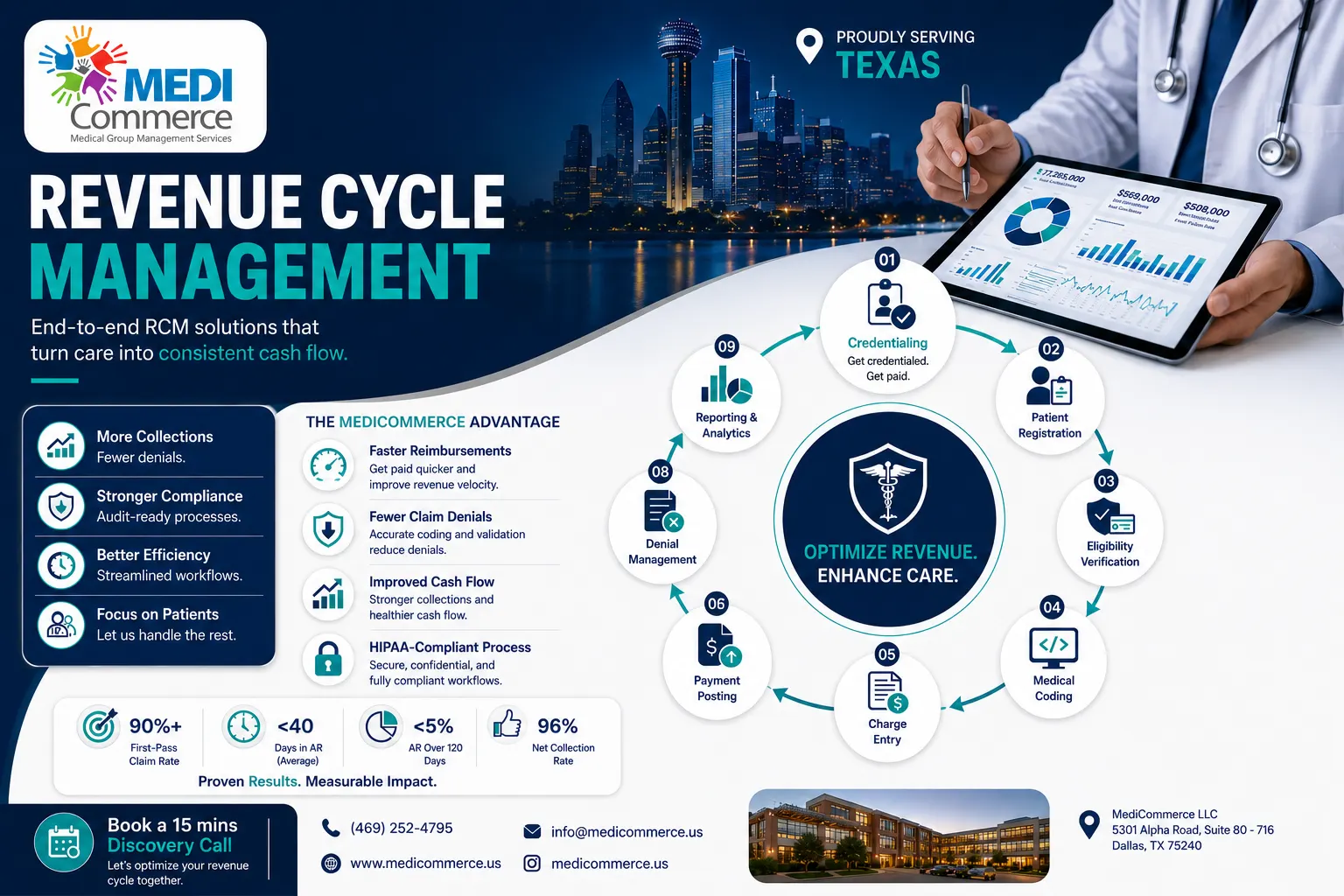
Quick answer: Revenue cycle management (RCM) is the end-to-end financial process that tracks a patient’s care from the moment a visit is scheduled to the moment the balance is paid in full. It links registration, insurance verification, coding, claims submission, and collections into one connected system and determines whether the care a physician delivers actually becomes revenue the practice can use.
For many physicians, Revenue Cycle Management in Texas still sounds like back-office plumbing, something the billing team handles while doctors focus on patient care. That framing may have made sense a decade ago. It doesn’t anymore.
In 2026, more than 4 in 10 providers reported denial rates above 10%, well past the 5–10% range the Healthcare Financial Management Association (HFMA) considers acceptable. Every denied claim represents care already delivered; the cost is sunk, and the only open question is whether the practice gets paid. Research cited by Becker’s Hospital Review estimates 90% of denials are preventable, yet close to 60% are never reworked, meaning that revenue isn’t delayed. It’s gone.
The 3 Phases and 9 Stages of Revenue Cycle Management
Front-end (before the patient is seen):
- Pre-registration and scheduling, where demographic and insurance data first enters the system;
- Insurance eligibility and benefits verification, which prevents the most common category of denial
- Network participation verification, which prevents any out-of-network claims denial
- Prior authorization, secured before care is delivered, not after; and
- Point-of-service financial counseling, which improves downstream patient collections.
Mid-cycle (during and after the visit):
- Charge capture: since missed charges are invisible revenue loss, nothing gets denied; it’s simply never billed.
- Medical coding and clinical documentation, translating the encounter into ICD-10, CPT, and HCPCS codes, the single highest-leverage stage for preventing denials; and
- Claim scrubbing and submission, checked against payer edits and NCCI bundling rules before it ever reaches the payer.
Back-end (after submission):
- Payment posting, remittance, and denial management, routing denials into a structured appeals workflow instead of letting them age silently;
- Review and send the patient balance statement. AR follow-up, patient collections, and reporting, which feeds data back into the front end to prevent repeat errors.
These nine stages form a loop, not a line; a denial surfacing in stage 8 almost always traces back to a gap in stages 2, 3, or 6.
The Metrics Worth Tracking
|
Metric
|
Benchmark
|
|---|---|
|
Denial rate
|
Below 5% (top quartile, MGMA); 8–10% average; above 10% signals a problem.
|
|
Net collection rate
|
~96% (MGMA benchmark)
|
|
Days in AR
|
Under 40 is strong; over 60 means cash is genuinely stuck.
|
|
Clean claim rate
|
95%+ is considered healthy.
|
|
AR over 120 days
|
Under 5–10% is the target.
|
A blended denial rate under 5% can still hide one payer denying 15% of claims while others stay near zero; track denials by payer, not just overall.
Why RCM Is Harder in 2026, and Where AI Actually Helps
Payer-side AI adjudication now catches mismatches a human reviewer might have missed, and CMS’s Interoperability and Prior Authorization rule is pushing payers toward electronic workflows still mid-transition. Rolling NCCI bundling-edit updates mean outdated edit tables can generate denials on services that were compliant months earlier.
On the technology side, roughly 63% of healthcare organizations have adopted AI or automation in revenue cycle workflows, yet only about 15% report a clearly positive ROI so far. The gap isn’t the technology; it’s that AI only adds value layered on top of clean, well-structured workflows. The strongest evidence for impact is in real-time eligibility verification, prior authorization automation (turnaround reductions of up to 80% in documented deployments), and pre-submission denial prediction. Fully autonomous coding and appeals still benefit from human oversight. The right question for a physician evaluating a partner isn’t “Do you use AI?” It’s “Where specifically, and what’s the measured impact?”
In-House vs. Outsourced RCM
|
Comparison Factor
|
In-House
|
Outsourced
|
|---|---|---|
|
Staffing risk
|
Fully exposed to turnover and coverage gaps.
|
The vendor's problem to solve
|
|
Specialty expertise
|
Limited to what your team has learned
|
Access across payer types and specialties
|
|
Cost structure
|
Fixed payroll regardless of collections
|
Often contingent-fee, aligned with results
|
|
Best fit
|
Larger groups with dedicated RCM leadership
|
Independent physicians, small-to-mid groups
|
Roughly two-thirds of provider organizations now outsource all or part of their revenue cycle, driven mainly by workforce shortages, making it the operational default rather than a fringe decision.
What to Ask Before You Hire an RCM Partner
- What is your first-pass claim rate, and how is it measured?
- What are your average days in AR, broken out by payer?
- What share of your clients’ AR sits past 120 days?
- Is denial management reactive, or is it built around pre-submission claim scrubbing?
- Do you specialize in my practice type and specialty?
For context, MediCommerce’s own client result, over 90% first-pass claim rate, under 40 days average AR, and under 5% of AR past 120 days, reflect the range a well-run RCM partnership should deliver. If a prospective partner can’t speak to comparable numbers, treat that as a signal.
How MediCommerce Supports Physicians Across Texas
MediCommerce works as a revenue cycle management and operations partner for independent physicians and nurse practitioners, medical groups, ambulatory surgery centers, home healthcare agencies, radiology and imaging centers, and rural hospitals across Texas, covering the full cycle rather than one stage in isolation:
- RCM Billing: Charge entry through AR, managed end-to-end
- Medical Billing and Coding & AR: Clean-claim submission built to prevent denials at the source
- Benefits Verification, Prior Authorization & Scheduling: Stopping denials before a claim ever exists
- Credentialing and Contracting: Provider enrollment managed to prevent revenue gaps
- RCM Staffing Solutions: Coding, prior authorization, and AR staff that plug into your existing team
- Clinical Operations Support: Pre-charting and coding audits that keep practices audit-ready
Frequently Asked Questions
What is revenue cycle management?
RCM is the process healthcare organizations use to manage the financial and administrative steps connected to patient care, from scheduling and insurance verification through coding, claims submission, and final payment.
Is RCM the same as medical billing?
No. Medical billing, generating and submitting claims, is one component of RCM, which also covers eligibility verification, prior authorization, coding, denial management, and patient collections.
What's a good denial rate?
Top-quartile practices stay below 5% (MGMA); the broader industry averages 8–10%. HFMA considers 5–10% acceptable; consistently above 10% signals a structural problem
Should I outsource RCM or keep it in-house?
It depends on scale. Larger groups with dedicated RCM leadership often have the volume to justify an internal team; independent physicians and smaller practices frequently get steadier cash flow from a specialized partner.
This guide reflects general benchmarks from MGMA, HFMA, and 2025–2026 industry research; results vary by specialty and payer mix.