
Remote Healthcare Staffing Solutions in Texas : The Revenue Cycle Capacity Decisions That Matter
Remote Healthcare Staffing Solutions in Texas : The Revenue Cycle Capacity Decisions That Matter
Physicians, independent medical practice owners, hospital administrators, healthcare executives, revenue cycle management (RCM) directors, medical billing managers, practice administrators, healthcare operations managers, and multi-location medical group decision-makers in Texas seeking remote healthcare staffing solutions to strengthen billing operations, manage administrative workloads, and support existing revenue cycle teams.
A practical approach to staffing the right healthcare functions without rebuilding an established revenue cycle operation.
A physician group can have a capable billing department and still find its revenue cycle falling behind.
The coding queue grows after a busy clinic week. Authorization requests compete with appointment scheduling. Payment posting remains current, but denied claims receive attention only after newer work is completed.
None of these situations necessarily calls for an entirely new billing operation.
They call for a closer examination of where work accumulates, which responsibilities need dedicated attention, and whether existing staff have enough capacity to maintain the required workflow.
For Texas healthcare organizations evaluating remote healthcare staffing solutions in Texas, that distinction matters. The objective is not simply to increase headcount. It is to place additional capacity where interrupted or delayed work affects the rest of the revenue cycle.
The First Staffing Decision Should Follow the Work, Not the Organizational Chart
Healthcare administrators often encounter staffing pressures that are difficult to interpret from headcount alone.
A department may appear adequately staffed while particular activities receive inconsistent attention. A coding specialist may be handling claim corrections. An authorization coordinator may also be managing referrals. A billing employee may alternate between payment posting and unresolved payer accounts.
The question worth examining is:
Which function needs dedicated capacity, and which responsibilities should remain with the existing team?
Consider three common operational patterns:
Operational observation | Staffing function worth evaluating |
Coding work accumulates as encounter volume increases | Dedicated medical coding support |
Authorization requests remain pending without timely follow-up | Prior authorization staffing |
Unresolved denials compete with daily billing activities | Focused denial management support |
Payment reconciliation falls behind incoming transactions | Payment posting specialists |
Insurance verification becomes difficult to complete before scheduled visits | Benefits and eligibility verification |
These examples are diagnostic starting points, not proof that additional staffing will resolve every problem.
An administrator should first establish whether the underlying issue involves workload, incomplete documentation, unclear ownership, payer requirements, or inefficient processes.
Adding capacity can address insufficient staffing. It cannot independently correct an inaccurate workflow.
The Hidden Cost of Asking One Employee to Own Too Many Revenue Cycle Functions
Cross-trained employees are valuable. They help practices maintain continuity when work volumes change or colleagues are unavailable.
But cross-training and divided accountability are not the same thing.
Consider a billing specialist responsible for charge entry, payment posting, and denied claims.
When daily submissions increase, charge entry naturally takes priority. Payment posting must continue because financial reconciliation cannot stop. Denial follow-up may receive whatever time remains.
The employee may be performing effectively, yet one part of the revenue cycle receives insufficient attention.
This is where targeted remote staffing can be useful.
Instead of transferring every revenue cycle responsibility to an outside organization, a practice can examine whether a dedicated specialist should manage a defined function while the internal team retains oversight of the wider operation.
MediCommerce’s RCM staffing model is structured around this distinction. Its published services allow healthcare organizations to engage dedicated professionals for specific revenue cycle activities rather than automatically outsourcing their entire billing department.
For a practice with an established internal billing team, that difference can make the staffing decision more focused.
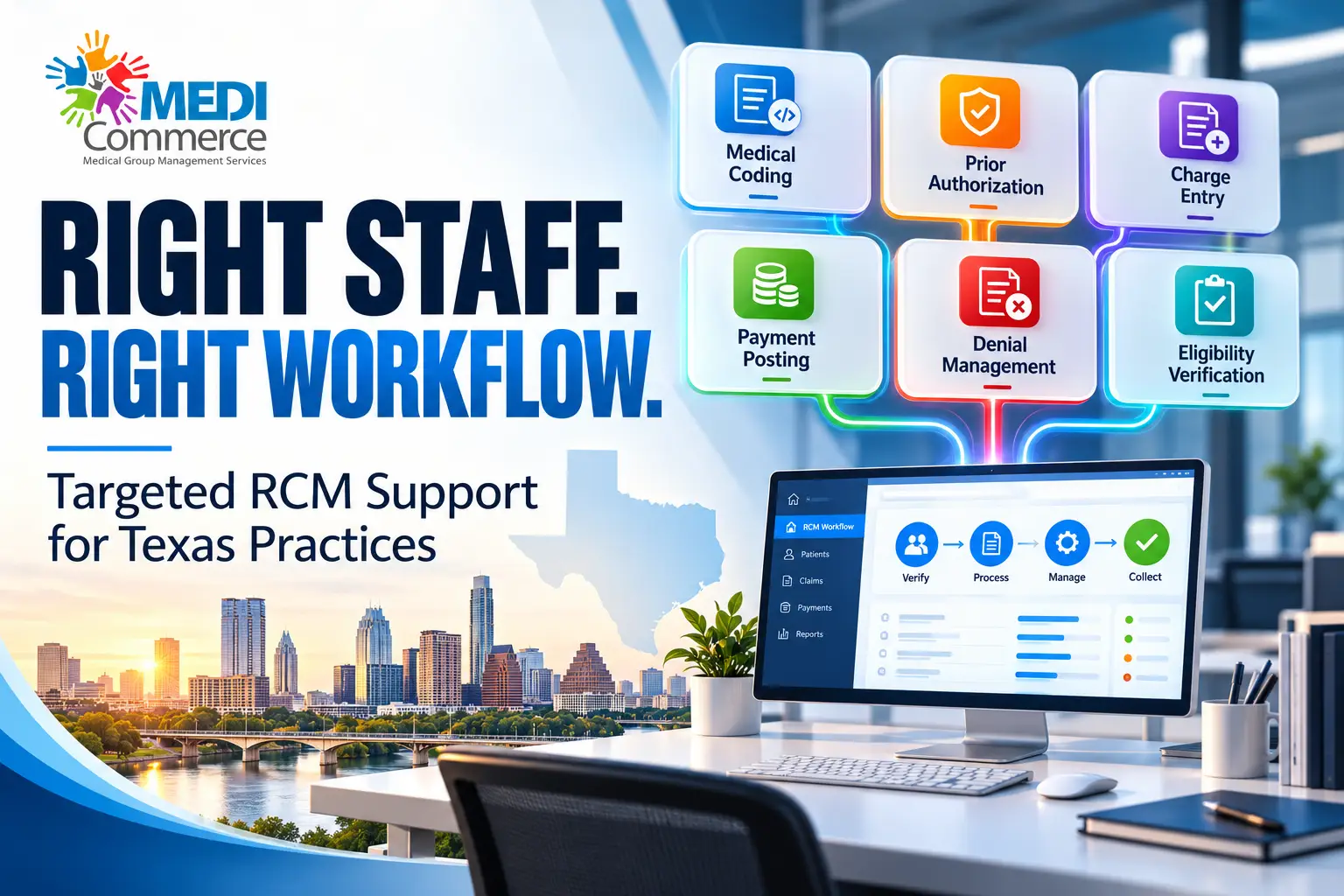
Six Revenue Cycle Functions Worth Evaluating Separately
Each revenue cycle function has different workload drivers, dependencies, and quality requirements. Evaluating them individually produces a more useful staffing discussion than treating billing as one Intake Coordinator.
1. Medical Coding: Capacity Must Follow Documentation Readiness
Additional coding capacity may be appropriate when encounter volume grows faster than the team’s ability to review and code completed records.
However, a coding backlog does not always indicate a shortage of coders.
Before adding medical coding support, examine:
- Whether clinical documentation is sufficiently complete.
- Which encounters are awaiting clarification.
- Whether coding work is delayed by missing records.
- How frequently payer edits require rework.
MediCommerce lists medical coding analysts among its staffing roles, with responsibilities involving ICD-10-CM, CPT, HCPCS, claim edits, and applicable payer coding requirements.
The practical staffing objective is to reinforce coding throughput while maintaining appropriate documentation and coding standards.
2. Prior Authorization: Assign Ownership Beyond Submission
Submitting an authorization request is only one stage of the process.
Staff may also need to verify requirements, monitor pending decisions, coordinate necessary documentation, and communicate authorization status to the scheduling or clinical team.
When these responsibilities are distributed informally, unanswered requests can remain in the queue.
Prior authorization staffing should therefore be evaluated around the complete assigned workflow, rather than the number of requests initially submitted.
MediCommerce provides authorization and benefits verification specialists who support eligibility checks, precertification, referral approvals, and pending authorization follow-up.
For physician groups managing several providers or locations, clearly assigned responsibilities can make the workflow easier to oversee.
3. Charge Entry: Protect the Connection Between Completed Care and Billing
Charge entry is closely connected to documentation availability, encounter closure, and billing accuracy.
When work accumulates, simply processing entries faster may not address the underlying cause.
Medical practice administrators should distinguish among:
- Encounters awaiting provider completion.
- Charges ready for entry.
- Claims requiring demographic or insurance corrections.
- Submissions delayed by clearinghouse edits.
MediCommerce offers charge entry and billing specialists who support claim generation, review, submission, and related billing tasks.
The staffing scope should reflect which of these activities genuinely requires additional capacity.
4. Payment Posting: Keep Reconciliation From Becoming a Secondary Task
Payment posting is sometimes treated as routine data processing, yet the information recorded during this stage affects downstream account management.
Incorrectly posted payments, unexplained adjustments, and unreconciled transactions can complicate the interpretation of accounts receivable.
Before extending payment posting capacity, review whether the team has clear procedures for posting insurance and patient payments, handling denials, and reconciling payment information.
MediCommerce identifies payment posting specialists as part of its staffing offering, including payment reconciliation and the identification of inconsistencies.
Dedicated support may be appropriate where transaction volume regularly competes with other billing responsibilities.
5. Denial Management: Separate New Work From Unresolved Work
A billing department can remain busy with current claims while previously denied accounts continue to age.
This happens when the same employees are expected to manage new submissions, payer correspondence, corrections, resubmissions, and older unresolved balances.
A useful staffing assessment separates denial categories before assigning additional personnel.
For example:
- Eligibility-related denials may require upstream verification improvements.
- Authorization-related denials may reveal process or documentation gaps.
- Coding-related denials may need specialist review.
- Payer processing issues may require dedicated follow-up.
MediCommerce offers focused denial management staffing for working denials and resubmissions.
The value of a dedicated role depends on giving that specialist a clearly defined work queue, appropriate access, and an escalation path for issues requiring internal decisions.
6. Eligibility Verification: Match Capacity to the Appointment Schedule
For many practices, eligibility verification workload follows the patient schedule rather than the volume of completed claims.
The staffing requirement may fluctuate with provider availability, scheduled procedures, and changes in patient volume.
When verification responsibilities are shared with reception, referrals, and scheduling, staff can face competing deadlines.
MediCommerce provides benefits and eligibility verification staffing as a defined RCM function.
Practices evaluating this support should first clarify when verification must occur, which payer details are required, and how unresolved coverage questions will reach the appropriate internal employee.
Remote Staffing Needs an Operating Model, Not Just a Job Description
The effectiveness of a remote staffing arrangement depends partly on how responsibilities are integrated into the existing organization.
A specialist may be assigned to coding, authorizations, or payment posting, but daily work still depends on timely information from physicians, clinical teams, scheduling departments, and billing leadership.
The practical objective is to establish clear ownership and usable communication pathways.
For example, an authorization specialist may manage payer follow-up while the clinical team remains responsible for supplying necessary clinical documentation.
Similarly, a coding analyst may process documented encounters but still require an established process for requesting clarification from the provider.
These boundaries should be agreed upon before additional staff begin working.
A Five-Point Readiness Check for Healthcare Administrators
Before implementing remote revenue cycle staffing, leadership can evaluate the proposed arrangement against five questions.
- Is the assigned work measurable?
A clearly defined queue is easier to manage than a broad instruction to help the billing department.
- Who owns decisions that require clinical or financial judgment?
Escalation responsibilities should remain explicit, particularly when documentation, payer disputes, or financial adjustments require review.
- Can staff work within established systems?
Workflow access and system compatibility need to be addressed during onboarding.
- Which performance indicators will be reviewed?
Useful measures may include queue aging, work completion, correction rates, pending authorization status, or unresolved denial volume, depending on the function.
- How will exceptions reach the correct person?
An unresolved issue should have an assigned escalation path rather than remaining indefinitely in an individual work queue.
These are recommended evaluation criteria, not claims that every staffing provider uses the same procedures.
A Better Staffing Review Starts With Function-Level Evidence
A practice considering additional staff does not need to begin with a broad departmental restructuring.
A more disciplined approach is to examine recent workload and separate activities into three categories:
Stable functions: Work is completed consistently with existing capacity.
Capacity-constrained functions: Work is properly defined but regularly exceeds available staffing time.
Process-constrained functions: Delays arise from unclear procedures, missing documentation, system limitations, or unresolved dependencies.
Only the second category directly supports a capacity-based staffing decision.
The third requires process correction, although additional staffing may still have a role after the underlying issue is addressed.
For example, increasing coding staff will not automatically resolve encounters awaiting physician signatures. Likewise, adding denial management personnel will not eliminate a recurring authorization problem upstream.
This distinction helps healthcare leaders avoid investing in staffing that does not address the source of delayed work.
The Right Staffing Structure Depends on What the Practice Already Controls
Remote staffing is not necessarily an alternative to having an internal revenue cycle department. It can be an extension of one.
MediCommerce distinguishes its RCM Staffing Solutions from its Core Billing Services.
Under its staffing model, organizations engage dedicated capacity for selected functions while working alongside their existing internal teams.
Its Core Billing Services operate through a different commercial arrangement, based on a contingent fee for billing services.
That difference matters during budgeting and procurement.
An organization seeking support for a defined activity may not need to reconsider its entire billing structure.
MediCommerce also offers healthcare operations support covering referral coordination, scheduling, and documentation management. These functions can be considered separately or alongside RCM staffing when operational requirements extend beyond the billing cycle.
For independent physicians, medical groups, multi-location providers, and hospitals, the appropriate arrangement depends on existing resources, patient volume, operational complexity, and the responsibilities leadership wants to retain internally.
Staffing Performance Should Be Reviewed by Function, Not by Headcount
A new staffing arrangement should not be evaluated simply by whether additional work hours have been added.
Healthcare leaders need visibility into whether the intended function is operating more consistently.
A practical review can connect each staffing area to relevant operational measures.
Staffing function | Measures worth reviewing |
Medical coding | Coding queue age, completed volume, documentation-related holds |
Prior authorization | Pending requests, authorization denial volume, revenue lost due to auth denials. |
Charge entry | Time from completed encounter to charge entry, outstanding charge queue |
Payment posting | Unposted transaction volume, reconciliation exceptions |
Denial management | Denial backlog, appeal or resubmission status, unresolved payer responses |
Eligibility verification | Verification completion before visits, unresolved coverage questions |
Intake coordinator | Referral backlog, referral conversion rate |
There is no single staffing performance target that is appropriate for every organization.
A small independent physician practice and a multi-location hospital group operate at different scales and face different payer, specialty, and system requirements.
Metrics should be selected according to each organization’s actual workflow and reviewed against its own established baseline.
Where MediCommerce Fits Into the Staffing Decision
For healthcare organizations evaluating remote healthcare staffing solutions in Texas, MediCommerce provides a function-specific RCM staffing model designed to complement existing revenue cycle teams.
Its published staffing capabilities include:
- Intake coordinator
- Medical coding
- Prior authorization
- Benefits and eligibility verification
- Charge entry and billing
- Payment posting
- Denial management
The company also identifies referral coordination and documentation processing roles within its staffing and operations offerings.
Its staffing process includes assessing requirements, defining a staffing plan, onboarding personnel into existing workflows, beginning the agreed work, and conducting ongoing management reviews.
MediCommerce primarily focuses on Texas healthcare organizations, including providers in the Dallas Fort Worth and Houston markets, while also serving clients in other states.
The most useful starting point is a discussion about the specific functions requiring support, rather than a general request for more billing employees.
Frequently Asked Questions
Can a Texas medical practice use remote staffing for only one revenue cycle function?
Yes. MediCommerce offers function-specific RCM staffing, allowing organizations to seek support for activities such as coding, prior authorization, eligibility verification, payment posting, or denial management without transferring their entire billing operation.
Does RCM staffing replace the practice's existing medical billing team?
Not necessarily. MediCommerce’s staffing model is designed to work alongside existing internal teams, with the engagement scoped to the specific functions requiring additional capacity.
Is remote healthcare staffing appropriate for multi-location medical groups?
Function-specific staffing can be considered by multi-location groups that need support across coding, authorization, verification, or other revenue cycle activities. The suitability of a particular arrangement depends on workflow requirements and available internal resources.
How is MediCommerce's RCM staffing engagement priced?
MediCommerce describes its RCM staffing service as a staffing-based engagement rather than a percentage-of-collections billing arrangement. Specific commercial terms should be discussed directly with the company.
Can staffing support be used for a temporary increase in workload?
MediCommerce states that its staffing solutions can support temporary volume increases and ongoing requirements. Its published service FAQ specifies a minimum of three months for temporary coding surge support.
Before Adding Staff, Identify the Work That Cannot Wait
Healthcare organizations rarely experience administrative pressure equally across every department.
Some tasks remain current. Others depend on overextended employees, delayed information, or workflows that have outgrown their existing staffing arrangements.
For physicians and practice leaders, the decision is not simply whether remote staff can perform revenue cycle work.
It is whether the organization can define the work precisely enough for additional staff to contribute without creating new uncertainty.
A stronger staffing plan starts with workload evidence, clear responsibilities, realistic performance measures, and an honest assessment of which problems require additional personnel rather than process changes.
MediCommerce supports Texas healthcare organizations with dedicated RCM staffing and related healthcare operations services. Practices evaluating additional capacity can explore the available functions and discuss how targeted staffing could fit within their existing operations.
Explore MediCommerce’s RCM Staffing Solutions:
https://medicommerce.us/healthcare-revenue-cycle-staffing/
Educational Disclaimer
This article is intended for general educational and healthcare operational planning purposes. It does not constitute medical, legal, financial, reimbursement, or regulatory compliance advice. Staffing decisions, billing procedures, payer requirements, and data-access arrangements should be evaluated according to each healthcare organization’s circumstances, contractual obligations, and applicable regulations.
© 2026 MediCommerce LLC. All rights reserved. MediCommerce LLC, 5301 Alpha Road, Suite 80-716, Dallas, TX 75240.