

Insurance Eligibility Verification Is Not a One-Time Check
Home /
Credentialing Solutions for Medical Practices: How They Streamline Provider Enrollment in Dallas
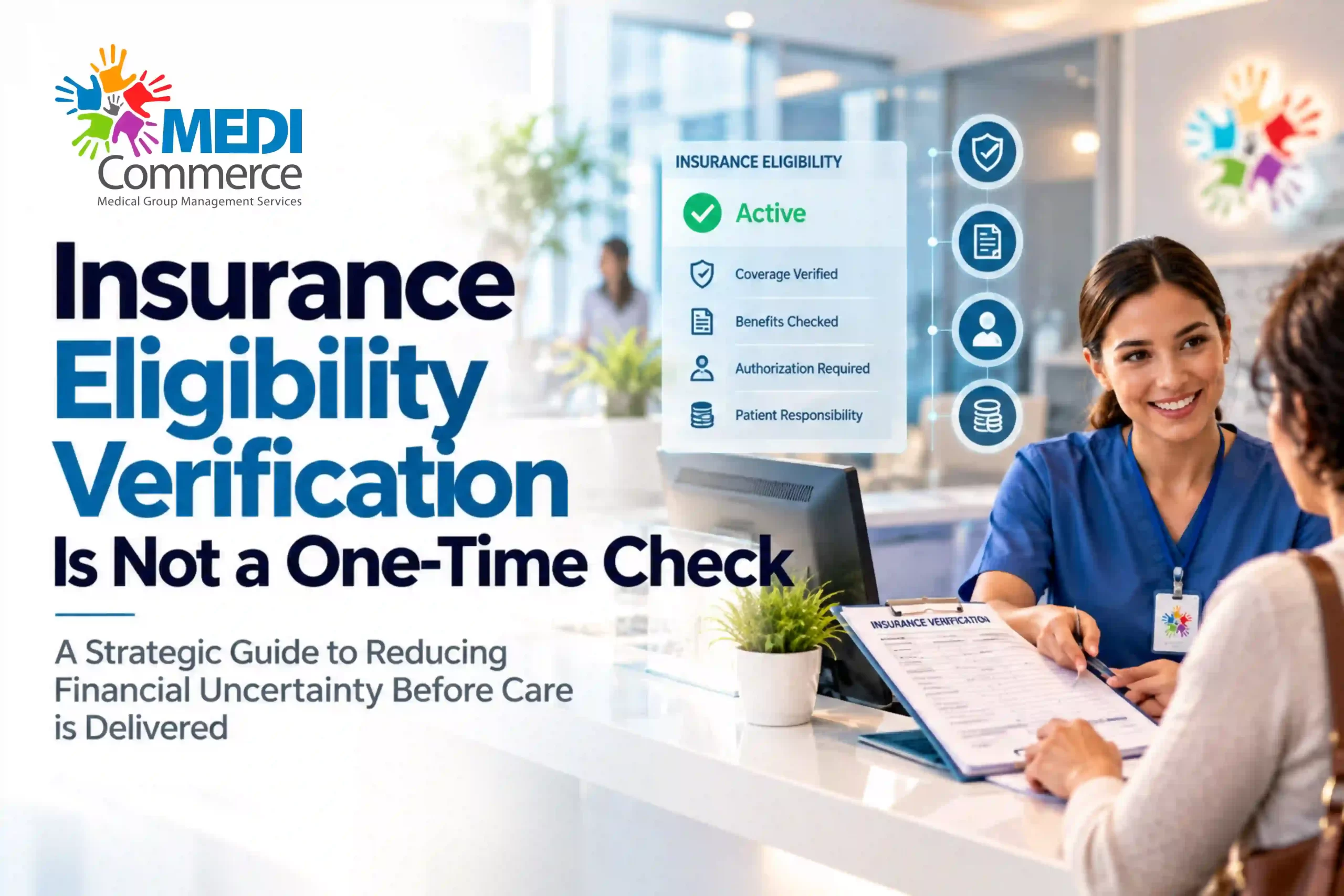
A practical guide for healthcare executives to reduce financial uncertainty before care is delivered
For hospital executives, physician-group leaders, and patient access managers: an insurance card does not guarantee coverage, and a successful eligibility response does not guarantee reimbursement for a specific service. Insurance eligibility verification is one important financial control-but it is not the same as complete financial clearance.
Outdated coverage details, identity mismatches, benefit limitations, or missed authorization requirements can move through patient access and later appear as denials, delayed payments, or avoidable administrative work. HFMA’s August 10, 2026 coverage, From Data Capture to Denial Prevention: Strengthen Patient Access Upstream, highlights how revenue problems may become visible after adjudication even when the causes entered the account much earlier.
Consistent Insurance eligibility verification helps teams identify risk earlier. The goal is not to guarantee payment before treatment. It is to identify uncertainty early, support informed operational decisions, communicate appropriately with patients, and reduce preventable rework.
1. Verification Is Not the Same as Financial Clearance
Insurance eligibility verification checks available information about a patient’s enrollment and coverage status. It does not automatically confirm that every planned service is covered or reimbursable.
A reliable Medical insurance verification process should review the following, as applicable:
- The patient’s identity and member information match payer records.
- Coverage is active for the anticipated date of service.
- The plan includes the relevant benefit.
- Network, referral, and prior authorization requirements are identified.
- Deductibles, copayments, coinsurance, and other potential patient responsibility are reviewed.
- Any additional payer-specific requirements are understood.
These checks answer different questions. A patient may have active coverage while a service remains subject to exclusions, medical-necessity criteria, or authorization requirements. A response received weeks before an appointment may also no longer reflect the patient’s coverage on the service date.
Insurance eligibility verification should be documented against the service date and the information actually returned. Organizations should record what has been confirmed, what remains uncertain, and who owns the next action. Verification completion alone should not be treated as proof that an account is financially cleared.
2. Five Patient Access Failures That Affect Revenue
Patient eligibility verification should be treated as an ongoing workflow, with clear ownership and risk-based follow-up-not a single box to tick.
- Checking coverage too early and never checking again. Coverage, member identifiers, or coordination-of-benefits information can change between scheduling and service. Set risk-based rules for rechecking coverage, including triggers, timing, and responsibility for resolving discrepancies.
- Treating active coverage as proof that a service is covered. Enrollment does not confirm that every procedure, diagnostic service, specialist visit, or facility service is included. Review relevant benefits, network and referral rules, patient responsibility, and additional requirements-especially for complex or high-cost services.
- Letting authorization gaps reach billing. Eligibility and prior authorization are separate processes. Where authorization applies, identify the requirement early and track the approval details against the service, provider, location, dates, or units as relevant. Measure authorization accuracy as well as turnaround time.
- Allowing patient or insurance data to mismatch. Differences in member identifiers, demographics, subscriber relationships, or records across scheduling, electronic health records, and billing systems can delay or reject claims. Define procedures to correct information across systems, use exception handling for automation, and investigate where errors originate.
- Closing tasks without assigning unresolved exceptions. Incomplete payer responses, portal outages, or unclear requirements need a documented next step. Specify who handles escalation, what evidence is retained, when the case is revisited, and how unresolved issues are communicated to scheduling, clinical teams, and billing. Measure accounts reaching the required clearance standard-not just tasks marked complete.
3. Texas Coverage Requires Program-Specific Workflows
Texas providers may work with commercial plans, Medicare, Medicare Advantage, Medicaid managed care, and Texas Medicaid fee-for-service. These programs do not all follow one universal verification process.
For Texas Medicaid, the Texas Medicaid & Healthcare Partnership (TMHP) publishes provider guidance and supports program-related administrative processes. Its provider manual explains that eligibility must apply to the time services are provided, while payment also depends on other conditions, including covered-benefit status and medical necessity.
For commercial plans such as Blue Cross Blue Shield and UnitedHealthcare, teams should consult the relevant plan’s eligibility information, benefits, provider requirements, and authorization rules. Requirements vary by product and arrangement.
4. Metrics That Show Whether Patient Access Is Working
In insurance verification in medical billing, executives should track more than verification volume and speed. Useful measures include:
- Verification completion and exception rates.
- Re-verification rates when coverage changes or timing gaps require another check.
- Eligibility-related and authorization-related denial rates.
- Financial-clearance turnaround time.
- Avoidable rework per account.
Segment results by payer, service line, and location where data allows. High completion rates do not automatically mean better reimbursement, and changes in denial rates should be interpreted alongside payer mix, service mix, and claim volume.
A practical review starts by establishing a baseline, tracing recurring exceptions to registration, payer data, benefits, authorization, or system interfaces, assigning corrective ownership, and then measuring changes in denials, rework, receivables, and patient communication issues.
5. Where Automation Helps-and Where It Does Not
In healthcare revenue cycle management, automation can reduce repetitive checks, data entry, work-queue sorting, and exception routing. But it cannot replace sound workflow design or judgment. Responses still need context; conflicting information may require human review, and an electronic transaction does not confirm that every reimbursement condition has been met.
Evaluate whether a solution supports the organization’s payer mix, distinguishes confirmed details from unresolved questions, routes exceptions to the right team, retains verification records, integrates with existing systems, and improves accuracy or downstream outcomes.
The aim is to make Insurance eligibility verification more consistent and reduce unnecessary manual work without losing oversight of complex cases.
6. When to Reassess th Processes and Procedures
A review may be appropriate when eligibility-related denials recur despite high completion rates, authorization gaps repeatedly reach billing, staff keep correcting information already captured elsewhere, financial clearance delays scheduling, or leaders cannot connect front-end exceptions to reimbursement outcomes.
First identify the source of friction. The right response may be process redesign, staff training, technology, additional capacity, or external support. Adding resources to an unclear workflow can increase activity without solving the underlying problem.
How MediCommerce Can Support Revenue Cycle Operations
For healthcare organizations, patient access works best as part of a connected revenue cycle. Insurance eligibility verification, benefits review, prior authorization, billing, coding, and accounts receivable follow-up should work together.
For organizations assessing Medical billing services in Texas, MediCommerce LLC supports healthcare organizations through:
- Benefits verification and prior authorization: Support for front-end verification and authorization workflows, subject to applicable payer requirements and available information.
- Medical billing and coding: Support for claim preparation and identification of billing or coding issues requiring review.
- Accounts receivable management: Claim-status follow-up, denial investigation, appropriate appeals, and outstanding-balance management.
- Credentialing and contracting: Support for provider enrollment and related contractual workflows.
For physician practices, multispecialty groups, and hospital leaders in Texas, the appropriate scope depends on existing systems, payer mix, staffing, and operational priorities. A useful starting point is to identify where exceptions originate, how often they recur, and whether current workflows resolve them before they affect billing.
If recurring eligibility issues, authorization gaps, or front-end rework are affecting your revenue cycle, contact MediCommerce to discuss your current workflow and potential areas for improvement.
Frequently Asked Questions
What is insurance eligibility verification in healthcare?
It is the process of checking a patient’s enrollment and coverage information through the applicable payer or program. Depending on the service, teams may also need to review benefit details, coverage dates, network status, and related requirements. It does not guarantee reimbursement for a specific service.
How often should providers verify eligibility?
Frequency depends on organizational policy, payer requirements, scheduling lead time, service type, and risk. Establish when coverage is checked before service and which changes trigger another check.
What is the difference between eligibility verification and prior authorization?
Eligibility verification checks enrollment and coverage information. Prior authorization is a separate review required by some payers for certain services. A patient may have active coverage and still need authorization.
How can verification affect claim denials?
Incomplete, outdated, or mismatched coverage information can contribute to eligibility-related denials. Missing authorization or unmet benefit requirements may be separate causes, so teams should review the payer’s explanation to identify the underlying issue.
How can Texas providers improve patient access?
Set clear verification standards, use the appropriate payer or program channels, document unresolved exceptions, coordinate authorization work, and monitor downstream denial trends. Texas Medicaid providers should consult the relevant TMHP provider manual for program-specific guidance.
Evaluate Your Revenue Cycle With MediCommerce
MediCommerce helps healthcare organizations manage critical revenue-cycle functions from billing and coding to eligibility, prior authorization, credentialing, AR, and denial management.
Book a 15-Minute Discovery Call to discuss your current revenue-cycle challenges and determine whether MediCommerce is the right fit for your organization.
MediCommerce
5301 Alpha Road, Suite 80 – 716
Dallas, TX 75240
Phone: (469) 252-4795
Legal Disclaimer
This article is for informational purposes only and does not constitute financial, legal, medical, or billing advice. Eligibility, coverage, prior authorization, and reimbursement requirements vary by payer, plan, service, and date. Verification does not guarantee payment. References to Texas Medicaid and TMHP are informational only; TMHP is a third-party administrator and is not affiliated with MediCommerce LLC. Healthcare organizations should confirm current requirements with relevant payers or programs and consult qualified professionals. MediCommerce services and outcomes may vary based on individual needs and circumstances.
© 2026 MediCommerce LLC. All rights reserved. MediCommerce LLC, 5301 Alpha Road, Suite 80-716, Dallas, TX 75240.