

Healthcare Credentialing in Texas: What Every Physician Should Know in 2026
Home /
Healthcare Credentialing in Texas: What Every Physician Should Know in 2026
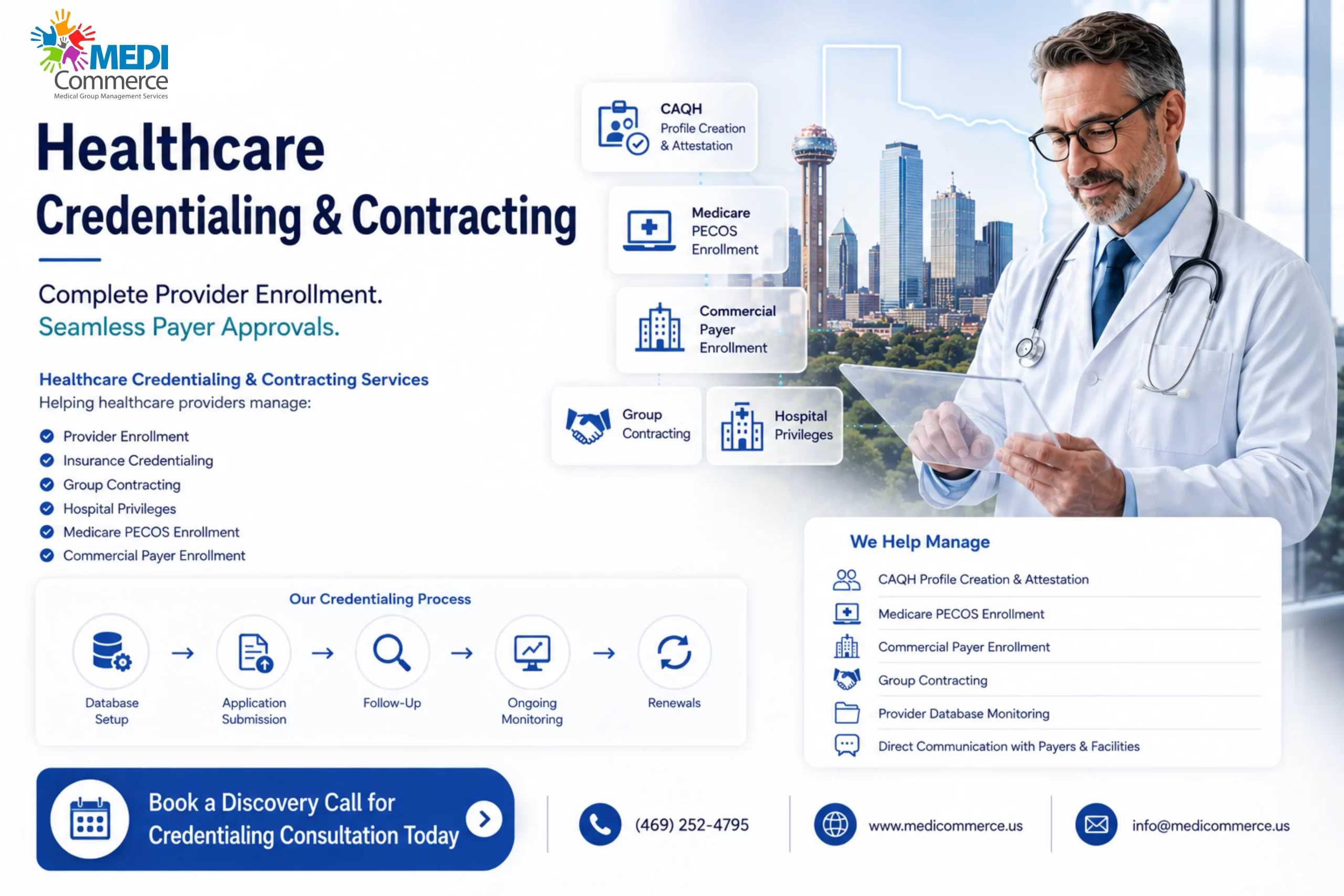
If you’ve ever pushed back a start date because a payer file sat untouched in a queue, you already know why healthcare credentialing has become one of the highest-stakes problems in American medicine. Delays now mean unbillable visits, stalled hires, and administrative burnout – a pattern felt as sharply in a Houston health system as in a two-physician clinic outside Lubbock.
Whether you’re a specialist relocating to Dallas, a hospitalist joining a critical access hospital in the Panhandle, or an independent physician opening a practice in San Antonio, healthcare credentialing decides when – and whether – you can legally treat and bill a patient. This guide covers how the process works, what changed for 2026, and how Medicommerce manages it for physicians statewide.
What Healthcare Credentialing Involves?
Healthcare credentialing verifies a physician’s education, training, licensure, board certification, and work history before they can join a payer network or hospital medical staff. This step, known as primary source verification, is handled directly by payers and hospital medical staff offices – confirming records with medical schools, residency programs, licensing boards, and databases like the National Practitioner Data Bank – before a file gets approved. One missing signature, and the application sits for weeks.
Payers and hospital committees own that verification step. What breaks down more often is everything around it – unsubmitted applications, follow-up that never happens, credentials nobody tracks until they lapse. That’s the administrative layer a medical credentialing company like Medicommerce manages for Texas physicians and groups, handling provider credentialing and enrollment from application through approval.
Credentialing, Privileging, and Contracting: What's the Difference
Credentialing verifies a provider’s qualifications. Privileging authorizes specific procedures at a specific facility. Contracting sets the payer agreement that determines reimbursement rates and network status. A physician can be fully credentialed and still be waiting on privileges or a signed contract – a mix-up that stalls new hires before their first shift.
Healthcare Credentialing Texas: What Changed for 2026
Texas runs on its own rulebook. Under House Bill 2038, the Texas Medical Board expanded expedited licensure pathways for physicians willing to practice in rural, underserved, or shortage areas – a response to gaps stretching from the Panhandle to the Rio Grande Valley. That helps rural hospitals recruit, but it doesn’t shorten the separate hospital-level and payer-level healthcare credentialing Texas organizations still have to complete before a provider can bill a claim.
Add the NCQA’s tightened 2025–2026 verification standards-shorter windows, new monthly monitoring-and credentialing offices in Dallas, Fort Worth, Houston, Austin, and San Antonio are under more pressure than ever to keep files moving without errors. For lean rural teams and independent practices, that pressure usually shows up as a delay.
How Medicommerce Handles Healthcare Credentialing Texas-Wide?
Medicommerce manages the administrative side of credentialing for physicians and hospitals across Dallas, Houston, San Antonio, Austin, El Paso, and rural Texas:
- Provider enrollment and insurance credentialing – CAQH profile creation and attestation, Medicare PECOS enrollment, and commercial payer enrollment service, tracked through to approved, in-network status.
- Group contracting – negotiating and maintaining payer contracts at the group level as a practice adds providers or locations.
- Hospital and facility privileges – working with medical staff offices to secure and maintain privileges, tracking each facility’s reappointment cycles.
- Provider database and document monitoring – tracking license, DEA, malpractice coverage, and certification expirations, with alerts sent well ahead of deadlines.
- Direct communication with payers and facilities – fielding documentation requests on a practice’s behalf.
Our process: database setup, application submission and follow-up, ongoing monitoring, then renewals as contracts and groups change – the same structure for one physician or a full group.
Frequently Asked Questions
What is healthcare credentialing?
It’s the process payers and hospitals use to verify a physician’s education, training, licenses, and work history before approving them to join a network or medical staff.
How long does healthcare credentialing take in Texas?
Most Texas providers should budget 60 to 120 days, depending on the facility, payer mix, and how complete the application is. Expedited licensure under HB 2038 can help rural and shortage-area physicians, but hospital and payer credentialing run on separate timelines.
Can I see patients before credentialing is finished?
Generally, no-treating patients before a facility or payer approves your file risks unbillable claims and disciplinary exposure. Locum and rural assignments sometimes allow provisional privileges, but this varies by facility.
How much does healthcare credentialing cost?
Costs vary by facility size, provider volume, and payer mix. Outsourcing to a credentialing management company is usually less expensive than a single month of delayed billing caused by a stalled application.
How often does a physician need to be re-credentialed?
Most payers and hospitals require re-credentialing every two to three years. Medicommerce tracks each provider’s renewal dates and required documentation so deadlines don’t get missed.
Ready to Simplify Healthcare Credentialing?
Legal Disclaimer
This content reflects MediCommerce LLC’s own service offerings and publicly stated performance metrics as of the publish date, provided for general informational purposes. MediCommerce’s own performance figures reflect its own published results and are not guarantees of future performance. Readers should verify current service scope directly with any vendor under consideration.
© 2026 MediCommerce LLC. All rights reserved. MediCommerce LLC, 5301 Alpha Road, Suite 80-716, Dallas, TX 75240.